Most people mistake LinkedIn for a distribution channel when it is really a trust system.
The feed is important. Because it is the most visible layer, it is often the one professionals focus on most. It helps you stay visible and top of mind. LinkedIn works best when your content does more than just show up in the scroll. When those layers work together, LinkedIn becomes more than a posting channel. It becomes a system that helps the right people find you, trust you, and remember you.
AI search is already changing who gets found
LinkedIn is no longer only a place where people browse. It is one of the places AI tools and search engines draw from when deciding who to surface, what to cite, and whose point of view deserves attention.
That changes what the right LinkedIn content strategy needs to do.
Semrush found that LinkedIn ranked second in citations across ChatGPT Search, Google AI Mode, and Perplexity in its March 2026 analysis, appearing in 11% of AI responses on average.
What matters is not only that LinkedIn is being cited. It is the kind of content that can keep working outside the feed over time.
Articles, newsletters, and other substantive LinkedIn content can have a longer life. They can be found in search, reinforce what someone hears about you, and shape perception before a call is ever booked.
A feed post can create visibility in the moment and help you stay top of mind, but it cannot carry the whole job on its own.
If everything you publish disappears into the feed, you miss the person who searches your name later.
Your LinkedIn profile needs to be part of the content strategy.
People form an opinion about you based on your LinkedIn profile. I don’t recall how many times I have asked people in one of my training sessions to pull out their business cards, rip a couple up, and exchange them with the people around them. With their eyebrows raised and a bit of a head tilt, someone will inevitably ask, “No one would do this!”
Ahh, now look at your LinkedIn profile, I say. Or, some of your employees, or your leader.
People look you up. They read your headline. They scan your About section. They swipe your Featured section. They look at your recent activity. They want to know whether you are worth their time.
That means your profile is a key part of the credibility layer.
Your profile, recent posts, longer-form content, and the consistency of your point of view all work together to build the credibility layer. They help people decide whether you are worth a meeting, an introduction, or a reply.
That decision is often made before you ever know you were being evaluated.
The sales cycle uses content as proof
This is where people underestimate the power of content.
Once a conversation is active, content is no longer about visibility. It becomes proof. A strong post gets screenshotted and dropped into a deck. A smart comment thread with the right people reinforces credibility. A sharp article helps a prospect understand how you think before the next call. The right piece at the right moment can shorten the explanation, reduce friction, and help a buyer move forward.
A client will say, “I read your post on how standing out starts with your profile. I updated mine, and I am getting more profile views.” I can tell when someone has read the content because they start using the language I use.
That is a different and more valuable use of content.
When you build content across layers, you are not only trying to get seen. You are creating assets that your team can use when a real opportunity is moving.
The feed matters, but it cannot do all the work
I am not making a case against the feed. But it is frenetic.
The feed matters because presence matters. It helps you stay visible with the people already in your network. It helps you stay familiar with the small percentage of buyers currently in the market. It gives people a reason to remember your name.
It is one layer, not the whole strategy.
LinkedIn’s B2B Institute argues that 95% of potential buyers are not in market at any given time, leaving only about 5% actively ready to buy. That is exactly why the feed cannot carry the full burden. It may help with the narrow in-market window, but the other layers support the much larger group who are still watching, researching, and deciding who they trust.
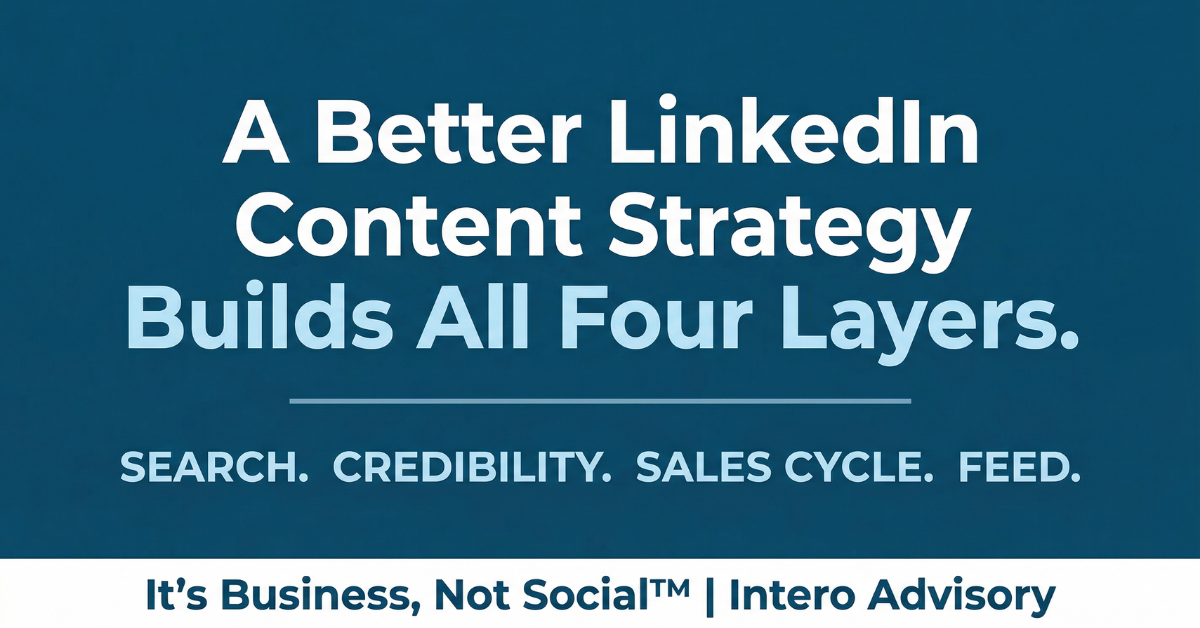
Each layer does a different job.
- Content for search makes you findable.
- Content for credibility helps people trust what they find.
- Content for the sales cycle gives your team proof they can use.
- Content for the feed keeps you present over time.
Most B2B professionals build one layer. The ones who get the most from LinkedIn build all four.
That is how you create a presence that keeps working long after the post is published.
Colleen McKenna is the founder of Intero Advisory. Since 2011, she has helped B2B leaders see, build, and activate the network they already have. It’s Business, Not Social™ is the methodology.