
Connected isn't the same as trusted. That distinction is at the center of everything we teach at Intero Advisory, and after fifteen years of working with professionals on LinkedIn, it remains one of the most misunderstood ideas in business development.
People post occasionally, do some searches, send a couple of messages, and wonder why nothing converts.
The opportunity is sitting in your existing network and the weak ties around it. The professionals reaping the benefits aren't more connected than you. They're running a different model entirely, one most people have never executed well.
These are Centers of Influence, and they are more valuable now than ever.
Connected Isn't the Same as Trusted
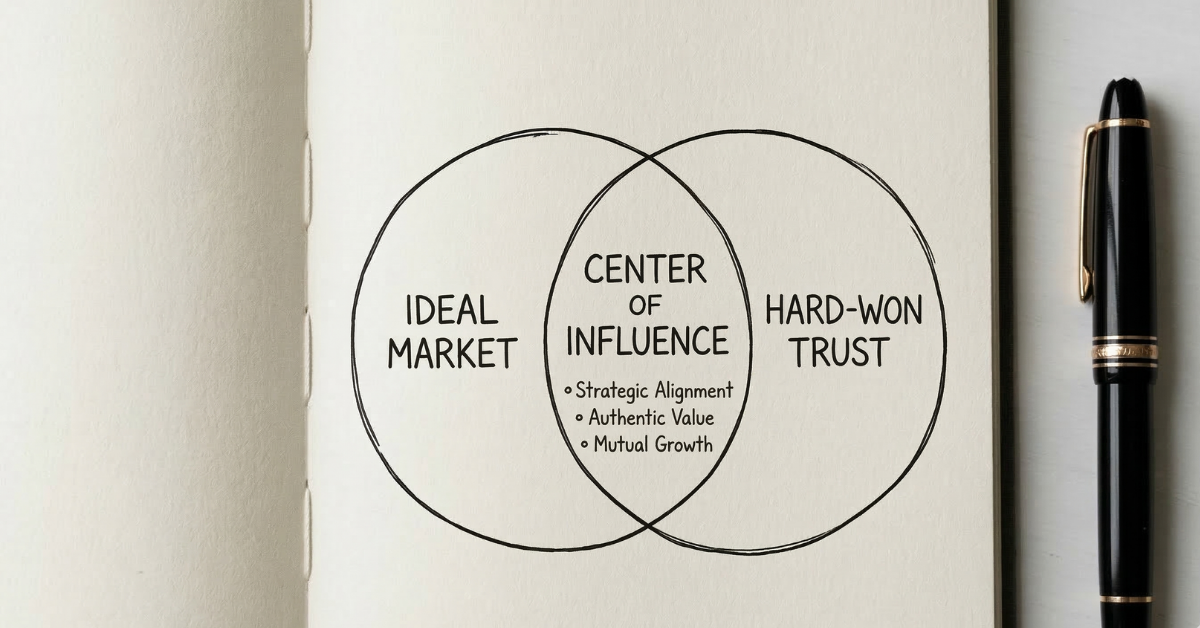
A Center of Influence is someone who sits at the intersection of your ideal market and their own hard-won trust. Not just connected to a lot of people, but actually trusted by them. There's a difference, and it matters.
Over the last 15 years, we've built COI relationships across many industries and locations. Each one starts differently and produces differently. What they share is this: the relationship runs on reciprocity, consistency, and a clear understanding that when one of us makes an introduction, our reputation travels with it.
Because introductions are a transfer of trust, that's the whole model.
The Intro That Should Open Doors is Creating Friction Instead
Most introductions break down in predictable ways.
The COI has to write a paragraph explaining who you are, what you do, and why it's relevant on top of their own message. That's asking someone to do your marketing for you. Most don't follow through, not because they don't want to help, but because it's work.
Or you hand them bullet points, but the timing is off. The message lands without context. The recipient has no way to self-qualify. It may or may not be relevant to them, and they have no way to know whether it's worth their time without a call they haven't agreed to yet.
Introductions should condense months of outreach into a single trusted moment. Done poorly, they create friction for everyone and quietly drain the social capital your COI just spent on you.
What a Frictionless Intro Actually Looks Like
Jim Cusick spent years as our head of business growth, watching this exact breakdown happen. To fix the breakdown, he built anchor, a done-for-you, video-first page at myanchor.io. I am an advisor, investor, and reseller because it is such an effective way to improve how you leverage a great COI workflow.
Here's what an introduction looks like now.
"Hey Jane, it was great seeing you the other day. Colleen McKenna might be able to help you all with LinkedIn. Here is a link to a page that will let you know if this is relevant in about three minutes. I'm happy to introduce you or you can schedule there."
That's the whole message: two sentences and a link.
Jane clicks, watches a short video, sees the proof, reads the context, and decides in three minutes whether this is worth her time. She self-qualifies and books if it's relevant. The COI never has to explain anything. They just send a link they trust.
It's less of a push and more of a pull. It saves social capital during the transfer rather than spending it. On the back end, we can see exactly when a COI shares our page, who's engaging, and whether it's converting. That tells us where to follow up, which COI relationships are most active, and where the workflow needs attention.
Sharing the page is easy. What comes before it is not.
What You Have to Earn Before the Intro
A COI will not put their name behind an introduction until they're confident in two things. You will show up the way they expect, and the person they're sending to won't feel like they've been sold to.
Building that confidence takes time, consistency, and reciprocity that most people never invest in. Not because they don't care, but because they don't have a system.
You should evaluate every potential COI across six criteria. Those are audience overlap, complementarity, generosity, reliability, genuine influence, and values alignment. That last one matters more than most people think. One misaligned introduction reflects on everyone in the chain.
If someone scores high across those criteria, then invest heavily. If they're impressive but misaligned, keep it light.
The rubric exists because visible is not the same as valuable.
They Took a Risk on You— Close the Loop
The common mistake made, and I have made it, is letting a strong COI relationship go quiet after the introductions start flowing. There are no updates on how the connection landed, no value moving back the other direction, and just silence until the next time we need something.
COI relationships don't survive that. The ones that do are the ones where value moves in both directions without scorekeeping, with learnings shared, introductions made, and a thanks when someone they referred becomes a client.
The COI took a risk and used social capital; closing the loop is the minimum.
How We Actually Use LinkedIn Inside This System
LinkedIn is where you identify, research, and stay visible to the people who matter.
Use it to find who your COIs are connected to, understand timing and context, and stay meaningfully present. A thoughtful comment on the right post does more than a comment on ten generic ones. A direct message with a specific reason lands differently than a connection request with no context.
We believe LinkedIn's data and functionality sit just behind your CRM as the most powerful revenue-generating tool available to customer-facing professionals. The problem is that almost nobody uses it that way.
It's Business, Not Social™ is the methodology to follow and a continual reminder.
You Don't Need a Big Network. You Need the Right Ten
Identify 10 potential COIs you don't have a real relationship with today. Score them against the criteria. Don't over-optimize the list, because the criteria will shift as you start cultivating relationships and learn more about how they operate.
Engage with their content not to get noticed, but to understand what they care about and where you can genuinely add something. Find a reason to meet, whether that's coffee, Zoom, or whatever fits. Make one introduction for them before you ask for anything.
When the time comes, and they need to send a message to someone like Jane, make it easy. Give them something they can point to in three minutes that explains it for them.
The introduction that moves fast is the one where your COI doesn't have to work hard to make it. Build toward that.
The Whole System Runs on One Thing
LinkedIn changes. AI is reshaping how people communicate. Noise is increasing. Attention is harder to earn.
None of that changes what actually drives revenue. A COI who trusts you enough to send two sentences and a link, and a recipient who self-qualifies in three minutes because everything they needed was already there.
That's the system. Build the trust, reduce the friction, close the loop, and it compounds.
Colleen McKenna is the founder of Intero Advisory. For fifteen years, she has helped professionals use LinkedIn as a business development tool, not a social media channel. It's Business, Not Social is the methodology. Centers of Influence are where it starts. She is also an advisor, investor, and reseller of anchor, the video-first page that makes the COI workflow frictionless.