
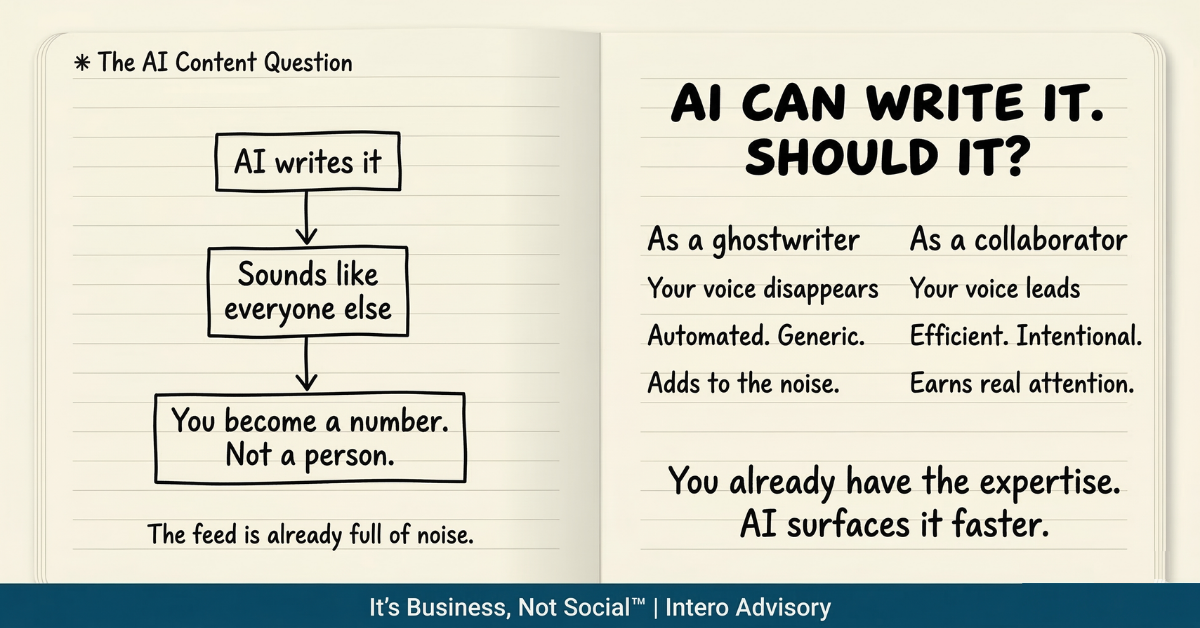
Every day, your LinkedIn feed is filled with words written by machines. Can you tell which ones?
AI has made it easier than ever to post. Easier does not always mean better.
As I run Intero Advisory while caregiving for my husband with Parkinson's, time is my most precious resource. AI helps me reclaim some of it — allowing more time for client calls, deliverables, and thinking about where our business is headed. That is AI's actual promise. More time back. Not more noise. Not the illusion of productivity.
The Real Question Is Not Whether. It Is How.
The real question is not whether AI can write your posts. It is whether using it makes your voice stronger or just adds to the noise.
Over the years, I occasionally delegated writing to my team. Some of that writing was phenomenal. They learned my style, my word choices, my tone. Active language, no widows, confident, encouraging.
How is that different from AI? It is not much different. I can give that same guidance to Claude, Gemini, or ChatGPT. In fact, I barely have to. They can articulate my tone and style more clearly than I sometimes can myself.
Same patterns, similar topics. I have read and edited every post. I contribute to the drafting, ideation, or final writing on all of them. That is not disingenuous. It is being efficient with a small team. If you have run a small business or served as a caregiver, you understand. If you have done both at the same time, you definitely understand.
Does AI-Generated Content Hurt Your Credibility?
It does in some ways.
People do not want to read AI-generated work if they know it is AI-generated. Though we can make the case that most people do not truly read content anyway. We see how long someone spends with our newsletter. We have become skimmers, not readers, our attention so fragmented that skimming is all we can expect unless someone is genuinely compelled or learning.
What really matters is not how long someone spent crafting a post. It is whether they value you.
When connection requests or posts are automated, you stop being a person in their eyes. You become a number in a spreadsheet. An open, a response, a lead. And when commenting, someone does not care enough to actually read and be thoughtful, so a poorly built AI bot summarizes the post, validates it, asks a generic question, and posts a rocket ship emoji. All for visibility. None of it is real.
The Better Question
Every day, someone asks: how do I get more LinkedIn attention? The algorithm changed, my views dropped.
Valid question. But the better question is this: how can I better serve my network and community by sharing my real experience, expertise, and humanity?
Frame it that way, and you stop devaluing people. There is no joy in learning from or buying from a bot. Forgetting that might be AI's biggest risk.
How to Use AI Without Losing Your Voice
Should you write your posts with AI? It depends.
If you are new to posting or have always struggled with putting your thoughts together, AI can support you. Use it as a collaborator, not a ghostwriter. Put in some of the work before you try to automate everything.
Start with AI to brainstorm, critique, and refine — but let your voice and expertise lead. Ask it to ask you questions to generate ideas that would be interesting to your audience. Write the draft yourself. Then ask AI for honest feedback on where you could improve.
Will that take more time initially? Yes. But your audience will feel the difference even if they never say so.
How This Post Was Written
The idea, the first draft, and the final draft of this post were written entirely by a human. The feedback, some trimming, and the second draft were done by Claude Sonnet 4.
Effective. Efficient. And the best part is, I get time back.
*This was again revised slightly with Claude Sonnet 4.6 in our content update done in March 2026.